Sunstory · Chapter 15
They danced for the Sun
Told by Zora Rae deSole
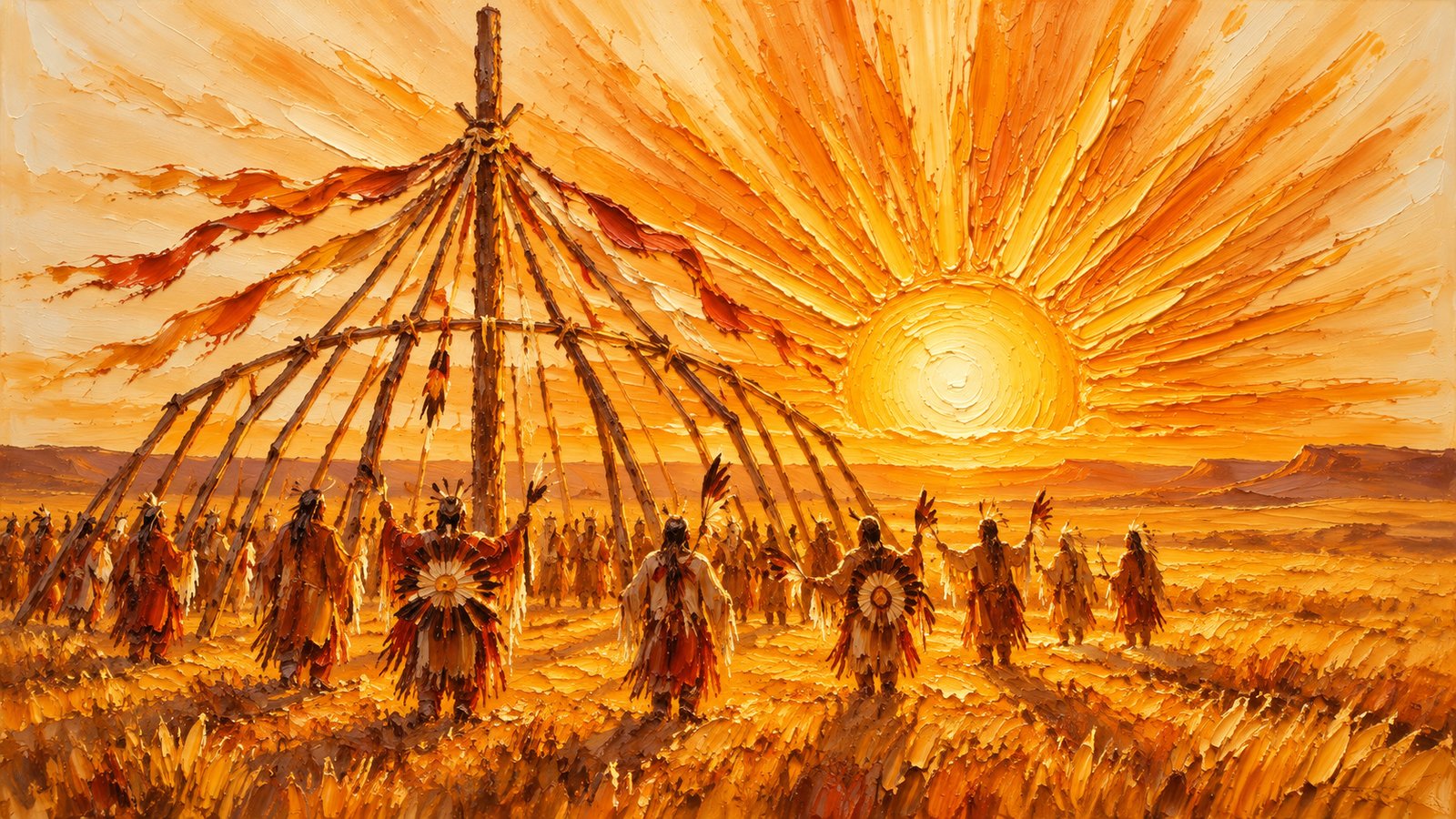
On the great plains of North America, there was no golden temple and no emperor descended from the sky. There was grass to the horizon, herds of buffalo like brown weather, and the biggest sky in the world. And once a year, when the herds gathered after the long winter, the nations of the plains gathered too, for the most important ceremony they had: the Sun Dance.
The Plains nations · then and nowA promise kept
The Sun Dance was held to awaken the earth after winter, to renew the community, and to give thanks: to the Sun, to the buffalo, to the Great Spirit whose gifts were everything. But here is what made it different from every festival in this book so far. At its heart was a promise. A dancer danced to keep a vow, made in exchange for a blessing: a sister healed, a family kept safe, a victory, a vision. The dance was the payment, paid gladly, in the coin of your own strength.
The whole village built it together. A cottonwood tree was chosen and cut with ceremony and raised as the center pole, the link between Earth and Sky, with the head of a buffalo, brought down by a hunter's single shot, fixed at its top. Around it they raised a circular lodge whose door faced east, toward the sunrise. For days before, the dancers fasted: no food, no water, no sleep. Then the drummers began, and the singers took up the sacred songs, and the dancers rose and fell on their toes, hour after hour, day after day, gazing at the Sun through the opening above the pole, dancing until they dropped. Some kept the hardest promise of all: they were fastened to the pole by thongs, and danced until the thongs tore free, a release, they said, from the bonds of ignorance, and they wore the scars with pride for the rest of their lives. I tell you this the way their grandchildren tell it: not as horror, but as the measure of what the Sun was worth.
The ban and the returnThe dance that would not stop
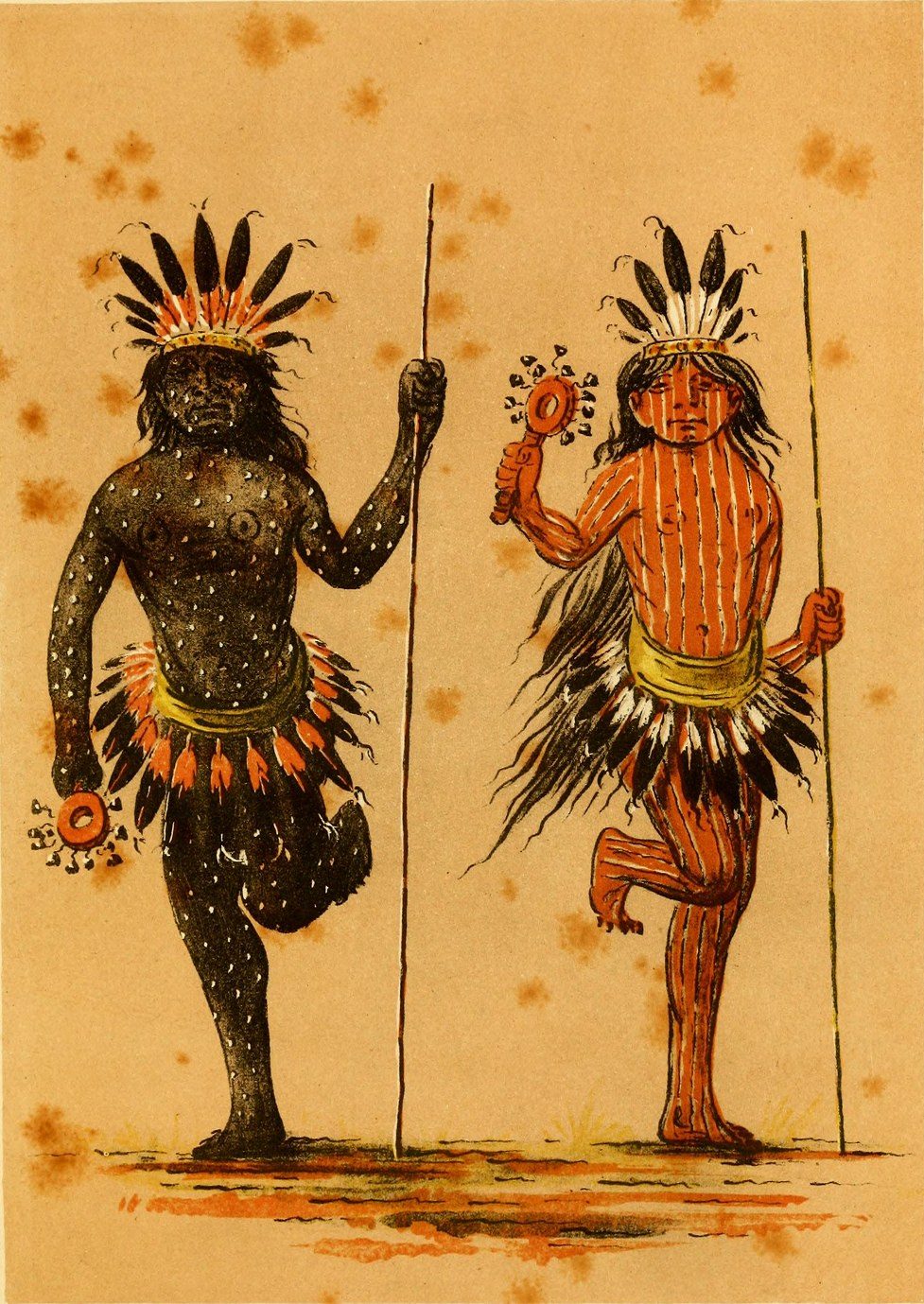
Where did it come from? Nobody knows, and that is the honest answer. Some scholars trace it to the Okipa ceremony of the Mandan, a cosmic new-year rite that the artist George Catlin watched and painted in the 1830s, with its own dancers costumed as Night and as the First Light of Creation. The nations themselves say simply that it was given to them.
And then it was taken. In the 1880s, the governments of the United States and Canada outlawed the Sun Dance, trying to break the peoples' unity by breaking their prayer. So the nations danced in secret, with lookouts posted, for seventy years. The bans loosened in the 1950s; in the United States, the right to pray in your own way on your own land was not fully protected in law until 1978, which is within living memory, which is maybe your grandparents' lifetime. Today the Sun Dance is held every year on the plains of two countries, openly, without the piercing, and the old promise still stands: the earth wakes, the people renew themselves, and the Sun is thanked. It outlasted the law. It outlasted everything they threw at it.
Now we cross the biggest ocean on Earth, the Pacific, to islands scattered like seeds across it, where people told a story I have loved since I first heard it. Once, the Sun moved too fast across the sky, and the days were too short to get anything done, and a boy named Maui decided to do something about it.
Notes and sources
- World History Encyclopedia · Sun Dance - the purpose and the promise, the lodge and the pole, the fast and the dance, Catlin and the Mandan Okipa, the bans, the secret years, the 1978 law, the dance today.
- Encyclopaedia Britannica · Sun Dance - the most important ceremony of the Plains nations, held when the buffalo gathered after the long winters.