Sunstory · Chapter 10
The Unconquered Sun
Told by Zora Rae deSole
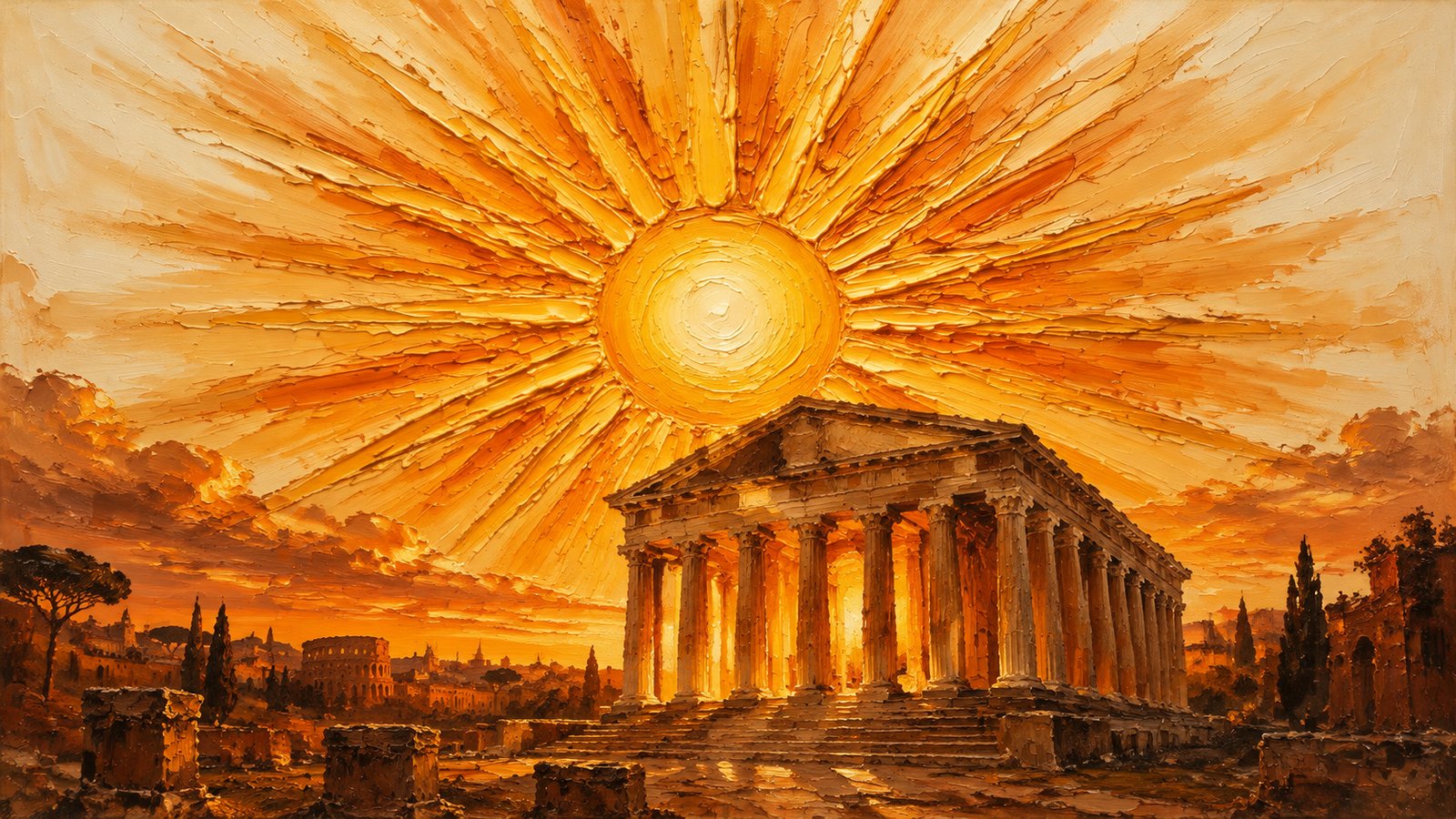
Rome absorbed Greece, gods and all, and where the Greeks had mostly told stories about the Sun, the Romans built it into the state. No people before or since has put the Sun so near the center of power.
Rome · from the 8th century BCThe Sun at the races
Rome's own Sun was Sol, and he was no import. Tradition said his temple on the Quirinal Hill went back to King Tatius, in the city's first generation, in the 8th century BC. And here is the most Roman detail in this whole book: Sol's other temple stood in the Circus Maximus, the great racetrack, because chariot racing was held under the Sun's protection. The four-horse chariot was consecrated to the Sun; the two-horse chariot belonged to the Moon. Both of Sol's temples held their foundation days in August, when the Italian sun is at its fiercest. Rome put its Sun god exactly where the noise was.
After the Great Fire of AD 64, the emperor Nero raised a bronze statue of himself 120 feet tall, the largest statue in the city. After Nero fell, the emperor Vespasian did something clever with it: he put a radiant crown on its head and rededicated it to the Sun. Vespasian was also the first emperor to put Sol on Rome's coins. The Sun was becoming a way for emperors to talk about themselves: always rising, always returning, impossible to defeat.
Syria to Rome · AD 219 to 274The boy priest and the Restorer of the World
In AD 219 a teenage emperor arrived from Syria, where he had been the hereditary priest of a sun god worshipped in the city of Emesa. His name was Elagabalus, and he did not do anything halfway: he rededicated a great temple on the Palatine to his god, and announced that this Sun, Sol Invictus, the Unconquered Sun, was now the principal deity of Rome, above Jupiter himself. Rome was horrified. Within a few years the boy emperor was killed by his own guards, and the cult was suppressed.
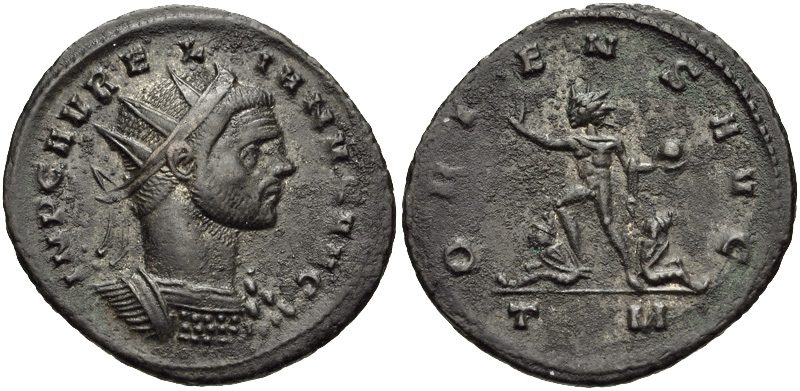
But the idea would not die. Fifty years later the emperor Aurelian, fighting Queen Zenobia of Palmyra at the Battle of Emesa, saw, or said he saw, a divine form fighting beside his troops. He won, visited the Sun's temple in that city, and went on to stitch a broken empire back together, returning to Rome hailed as Restorer of the World. In AD 274 he raised a magnificent new temple to Sol in Rome, loaded it with gold and jewels, founded a college of priests to serve the god, and established games in his honor. The Unconquered Sun was now the supreme deity of the empire: one Sun for one Rome, an emblem of an empire that could not lose.
December 25The calendar with two birthdays
Now the most famous date in this book. In the old Roman calendar, December 25 was the winter solstice, the shortest day, which the Romans called bruma; the poet Ovid called it the first day of the new sun, the last of the old. After bruma, the days begin, almost invisibly, to grow.
In AD 354 someone in Rome made an illustrated calendar book as a gift for a Christian aristocrat, and it has survived. In its calendar, December 25 is marked as a festival with thirty races in the circus: the birthday, almost certainly, of the Unconquered Sun. And in another section of the very same book, the oldest list of Christian anniversaries we have, December 25 appears again, for a different birthday: Christ was born in Bethlehem of Judea. It is the first time Christmas is recorded anywhere. Same book, same day, two birthdays.
Did Christmas take the Sun's day, or did both grow toward the solstice on their own? Historians still argue, honestly, in both directions. What nobody argues about is the day itself: the hinge of the year, the moment the Sun turns back toward us. One of Rome's last pagan emperors, Julian, wrote a hymn to King Helios and tried to bring the old Sun back; within a generation the empire had chosen the other birthday. The age of Sol Invictus ended. The solstice never noticed.
But Rome was never the whole of Europe. Far north of the empire's borders, where winter is long and dark and the Sun is a rumor for months, people told the story as a chase: a goddess in a chariot, driving as fast as she can, with a wolf right behind her.
Notes and sources
- Encyclopaedia Romana (University of Chicago) · Sol Invictus and Christmas - Sol Indiges and the Circus temples, Nero's colossus and Vespasian, Elagabalus, Aurelian's temple and priesthood, the Chronography of AD 354, bruma and December 25, the Christmas question.