Sunstory · Chapter 9
The boy who drove the Sun
Told by Zora Rae deSole
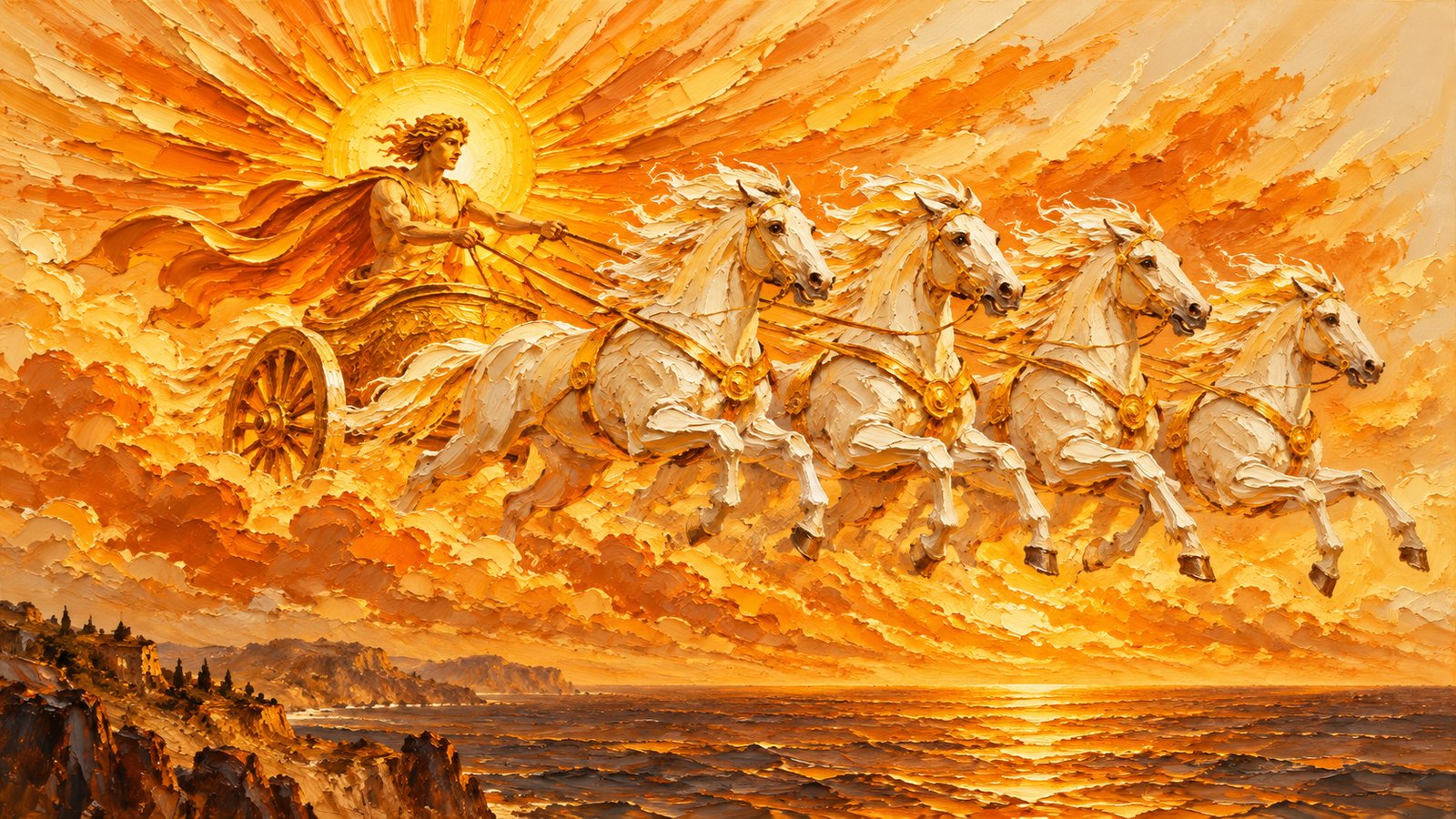
Greece is where this book changes again, because the Greeks did something unexpected with the Sun: they loved its stories more than its worship. They gave the Sun the best characters it has ever had, and then, mostly, declined to build it temples. Both halves of that are worth telling.
Greece · from the oldest songsA family made of sky
The Greek Sun was Helios, son of two Titans, Hyperion and Theia. His sisters were Eos, the Dawn, and Selene, the Moon: one family that is simply the whole sky, morning to night. Every day Helios climbed into a golden chariot and drove from the far east to the far west, wearing a crown of sun rays, seeing everything below him. The poets said nothing escaped those eyes.
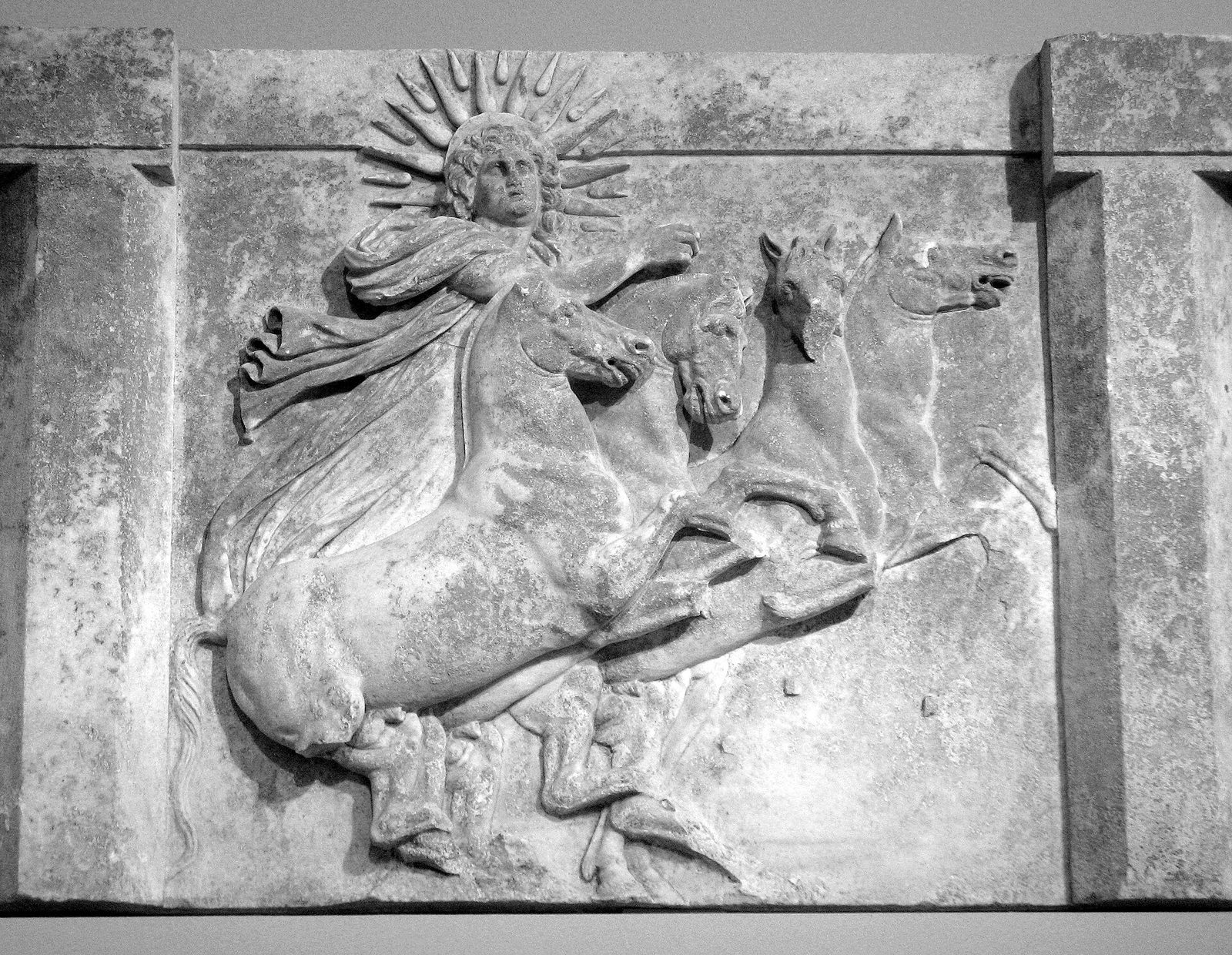
Greek artists loved him. On painted vases he drives his chariot along the rim of the world while the stars, drawn as boys, dive into the ocean as he approaches, morning putting them out one by one. On the Parthenon in Athens itself, the greatest temple in Greece, the sculptors carved Helios rising from the sea at the very edge of the pediment, as if the building could not begin without him.
The first Sun story every kid should hearPhaethon takes the wheel
Helios had a son named Phaethon, a mortal boy who grew up hearing, and half not believing, that his father was the Sun. So the boy traveled east to the palace of the sunrise to check. Helios was so happy to see him that he offered any gift at all, and Phaethon asked for the one thing a father should never hand over: the keys. One day, he said. Let me drive the chariot across the sky, one day.
You can feel the ending coming. The horses knew a stranger's hands at once. They bolted, veered, plunged too low and scorched the earth, climbed too high and froze it, until Zeus himself had to choose between one boy and the whole world. His thunderbolt struck Phaethon from the sky, and the chariot came home without its driver. The Greeks told this as a warning about wanting too much, too young. I hear something else in it too: even the Sun's own son could not do the Sun's job. Some work takes all day, every day, forever, and there is no shortcut.
Rhodes · 3rd century BCThe colossus and the chariot in the sea
And yet the Greeks mostly did not worship Helios with ceremonies; they said praying to the Sun was something other nations did. Except that Socrates, the most famous of all Greeks, greeted the Sun and offered it prayers each day, and except for one island that made him everything: Rhodes, named, they said, for the nymph Rhodos, who bore Helios seven sons. The Rhodians held games in his honor, and every year they drove a chariot with four horses into the sea as a gift to the god. Think of it: the people giving the Sun back his own ride, with love.
Rhodes was rich, and envied, and in 305 BC a Macedonian prince named Demetrius besieged it for a whole year and went home with nothing but a nickname: the Besieger of Cities. He abandoned so much equipment, including a siege tower 36 meters tall, that the Rhodians sold it all for a fortune, and there seemed no better way to spend a windfall than on a thank-you to their patron god. They built the Colossus of Rhodes: a standing statue of Helios some 33 meters tall, as high as a ten-story building, sheets of bronze over an iron frame, twelve years in the making, and one of the Seven Wonders of the Ancient World. An earthquake brought it down barely sixty years later. And here is the part I love: the fallen giant lay in pieces by the harbor for a thousand years, and people still crossed the world just to look at them. It never stood long. It has been standing in memory ever since.
In time, the Greeks folded Helios into another god: Apollo, lord of music, healing, and prophecy, who from the 5th century BC was increasingly imagined as the Sun itself, until the two became almost one. And then Greece was swallowed by an empire that would take the Sun more seriously than anyone before or since. Rome was coming, and with it a Sun it called Unconquered.
Notes and sources
- World History Encyclopedia · Helios - the family of Titans, the golden chariot, Phaethon, Socrates' daily prayers, the Greek distaste for sun cults, Rhodes, Apollo merging with the Sun.
- World History Encyclopedia · Colossus of Rhodes - the siege of Demetrius, the sold equipment, Chares of Lindus, Pliny's 300 talents and 12 years, the pieces lying by the docks for a millennium.