Sunstory · Chapter 8
The goddess in the cave
Told by Zora Rae deSole
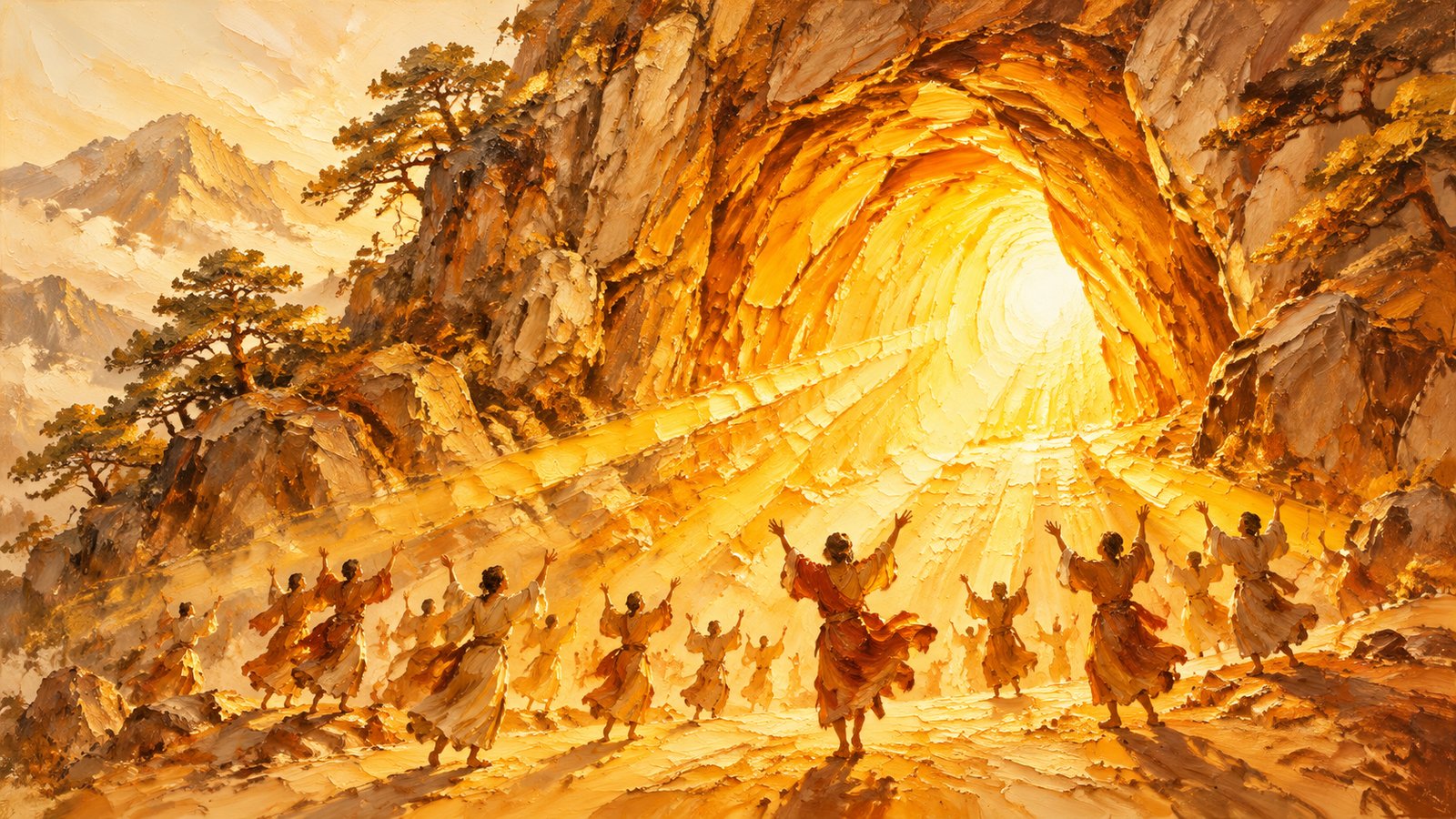
East of China, across the sea, lies a chain of islands that named itself for the sunrise: Nippon, Japan, which means where the Sun comes from. The flag is a single red Sun on white. And in the Shinto religion of Japan, the Sun is not a god. She is the goddess: Amaterasu Omikami, the Great Divinity Who Lights the Heavens, the most important deity in the whole tradition.
Japan · the oldest storiesBorn from a left eye
Amaterasu's beginning is one of the strangest in this book. Her father, the god Izanagi, had gone down to the land of the dead, and when he escaped he washed himself in a river to become clean again. As he washed his left eye, out of it was born the Sun. He made his new daughter the ruler of the High Celestial Plain, the heaven of the spirits.
She had a brother, Susanoo, the god of storms, and if you have a brother you can probably imagine how that went. They quarreled constantly. Susanoo was wild and careless, and one day he played a prank so cruel, bursting in on his sister with a monstrous ruined horse while she sat quietly weaving with her little sister, that Amaterasu did something no one expected. She left. She found a cave, rolled a boulder across its mouth, and shut herself inside.
The night that lastedHow the gods laughed the Sun out of her cave
With the Sun in a cave, the world went dark. Not evening-dark. Dark dark, with no dawn coming, and evil spirits began to run loose. The gods, eight million of them, gathered outside the cave and held a council, and what they came up with was not force. It was a party.
They brought roosters and set them crowing, as if morning had somehow come without her. They hung a tree with jewels and put a mirror in its branches. And then the goddess Ama-no-Uzume began to dance, stamping on an overturned drum, dancing so wildly and so ridiculously that the eight million gods roared with laughter. The noise was too much for Amaterasu. She opened the boulder a crack and peeked out to see what could possibly be so funny in a world with no Sun. The first thing she saw was her own face blazing in the mirror, and while she stared, astonished, the strongest of the gods grabbed the boulder and hauled her out. Light poured back over the world.
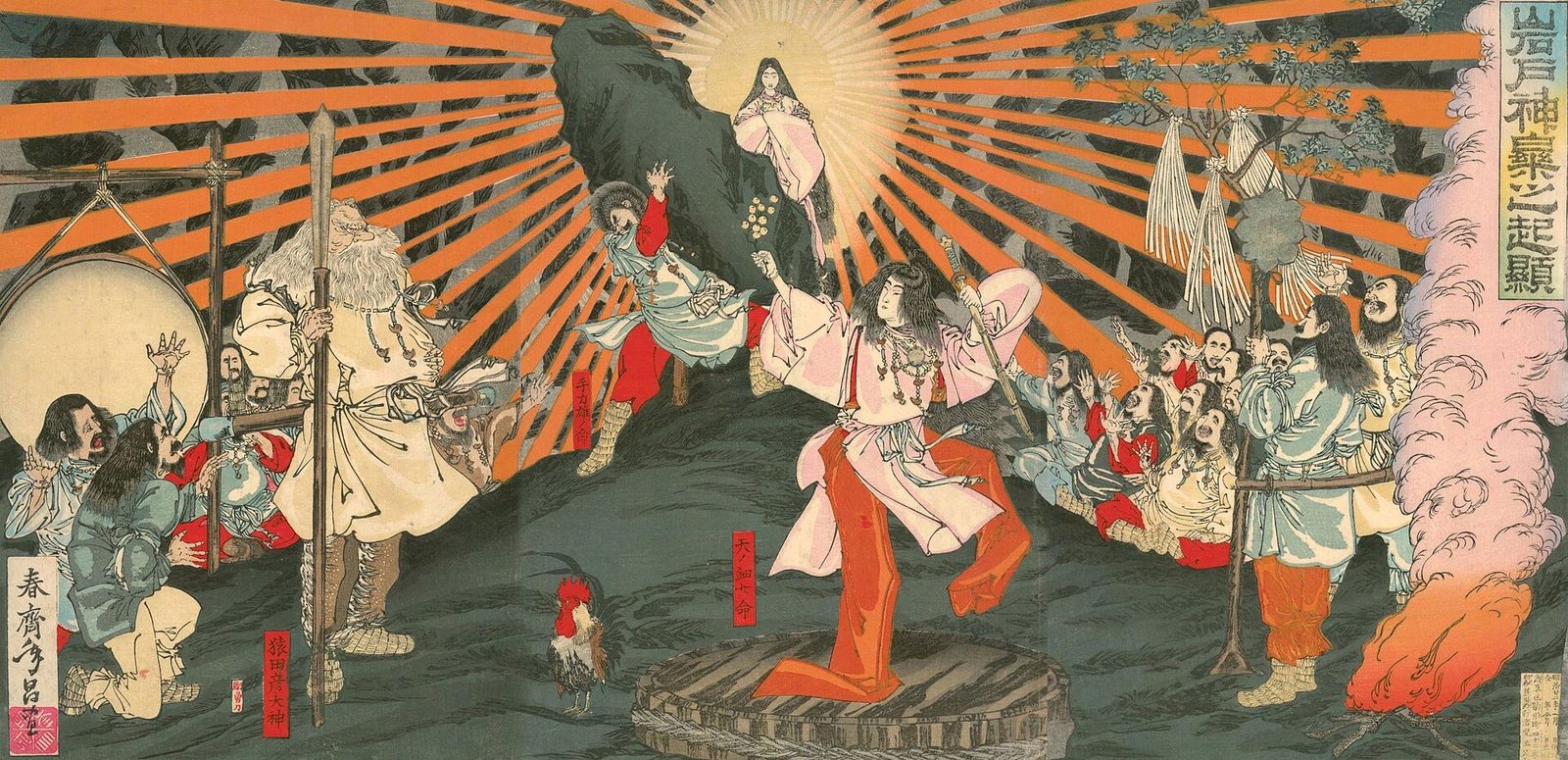
I love this story because of what saves the world. Not an army, not a spell: curiosity and laughter. The Sun came back because everyone was having too much fun to miss.
Ise · for about two thousand yearsThe mirror you are not allowed to see
Amaterasu's family kept going. She sent her grandson Ninigi down from heaven to rule the islands, and she gave him three treasures: a curved jewel, a sword, and that same mirror from the cave. Those three treasures became the regalia of the emperors of Japan, who claimed descent from the Sun herself, starting with the first emperor, Jimmu. A family line from the goddess of the Sun to the palace in Tokyo: that is how much she mattered.
And she is still worshipped. At Ise, on the Pacific coast of Japan, stands the most sacred shrine in Japan, built for Amaterasu about two thousand years ago, where the Holy Mirror is kept inside the innermost courtyard, behind four fences, where almost no one ever sees it. Here is the part I find beautiful. Every twenty years, the people of Ise build the shrine again, exactly the same, on the empty lot beside the old one, and carry the mirror to its new home. Then they take the old shrine down. They have been rebuilding it, the same way, for over a thousand years: the house of the Sun, forever new, because the people keep making it so.
Now turn west, across the whole of Asia, to the islands and hills of Greece, where the Sun got a chariot again, and where a boy named Phaethon made the most terrible mistake a teenager has ever made: he asked to drive it.
Notes and sources
- World History Encyclopedia · Amaterasu - born from Izanagi's eye, Susanoo and the cave, the dance and the mirror, Ninigi and the three treasures, the imperial line.
- Ise Jingu, official site · About Jingu - the Holy Mirror, the 2,000-year enshrinement, the four fences, the Shikinen Sengu rebuilding every twenty years.