Sunstory · Chapter 7
Ten suns in a tree
Told by Zora Rae deSole
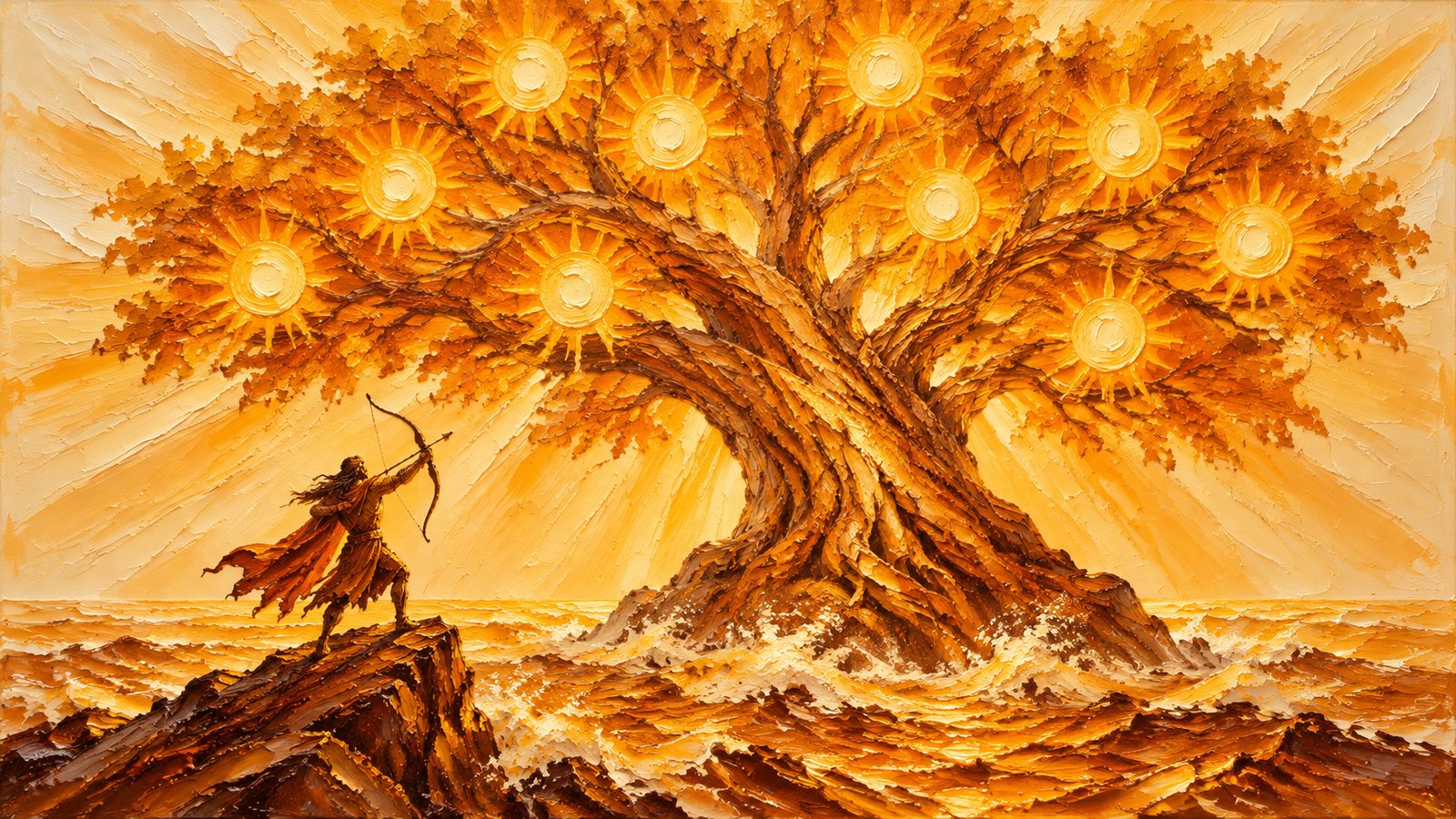
In China, the oldest Sun stories begin with too much of a good thing. Once, they said, there was not one sun in the sky, but ten.
China · a story at least 4,000 years oldThe mother of the suns
The Classic of Mountains and Seas, one of the strangest and oldest books in China, tells about a country far beyond the eastern sea, where a woman named Xihe lived by a warm pool called Ganyuan, the Sweet Abyss. Xihe was the wife of the sky god Di Jun, and she had ten children. Her children were the suns, and she bathed them in the warm water herself, like any mother with ten small, glowing, hard-to-manage sons.
Nearby rose the Fusang, an enormous tree standing in a valley of hot springs, and the tree was the suns' home. Nine of them rested on its lower branches, says the old book, and one sat at the very top: the one whose turn it was to shine. One sun a day, in orderly shifts, while their mother watched from her pool. It is such a gentle arrangement. You can probably guess that it did not last.
The day all ten rose at onceThe archer and the falling suns
A much later book, the Huainanzi, tells what went wrong. In the time of the good emperor Yao, all ten suns came out together. Ten suns at once is a catastrophe: the crops scorched in the fields, the grasses died, the people had nothing to eat, and monsters crawled out to prey on them.
So Yao sent for Hou Yi, the Lord Archer, the greatest bowman in the world. Hou Yi looked up at that burning sky, drew his bow, and shot the suns down, one after another, until only one was left: exactly enough light and warmth for the world to live. The people rejoiced, the story says, and made Yao their emperor.
People were already telling this story more than four thousand years ago, and they kept improving it. In one version, it explains how the Sun and the Moon came to take charge of day and night. In another, my favorite detail of all: the nine shot suns fell into the sea and became a hot rock, which boils away the water around it forever. That, the storytellers said, is why the sea never overflows.
Painted two thousand years agoThe crow in the Sun
The Huainanzi also tells you what lives inside the Sun: a crow with three legs. The Moon, if you are wondering, contains a toad.
This is not just words in old books. At a place called Mawangdui, archaeologists opened the tomb of a Han dynasty lady and found a painted silk banner, made some two thousand years ago, that was carried at her funeral. At the top of the banner is heaven, and there it all is: the red Sun with its black crow inside, the pale crescent moon with its toad, and down the side, the little round suns resting among the branches of their tree, waiting for their turns.
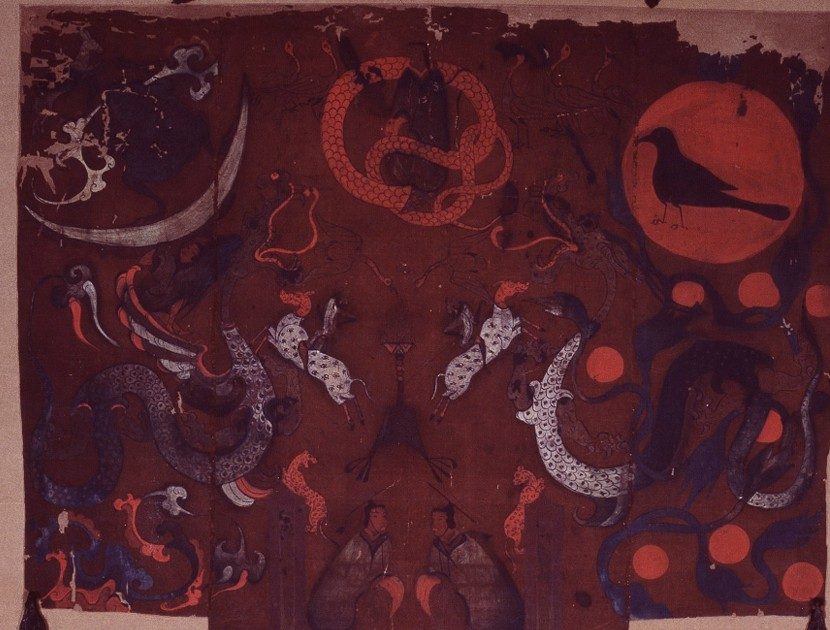
Think about that for a moment. Long before anyone built a telescope, a family loved a story so much that they wrapped their dead in a picture of it: the crow in the Sun, the suns in the tree, the whole bright mythology of the sky, going with her into the dark.
The archer left one Sun over China. Now sail east across the sea, to the islands of Japan, where the Sun was not a bird, or a wheel, or a boy with a bow. There, the Sun was a goddess: Amaterasu, the greatest deity in the country, and the ancestor, they said, of its emperors.
Notes and sources
- Smithsonian Folklife Festival · Hou Yi and the Ten Suns - the archer, the nine shot suns, the 4,000-year age of the story, the rock in the sea.
- Classic of Mountains and Seas · Great Wilderness South and Beyond the Eastern Sea (Chinese Text Project) - Xihe, wife of Di Jun, bathing the suns in the Sweet Abyss; the Fusang tree with nine suns below and one above.
- Huainanzi · Surveying Obscurities and The Quintessential Spirit (Chinese Text Project) - the ten suns in Yao's time and Yi's arrows; the three-legged crow in the sun and the toad in the moon.