Sunstory · Chapter 6
The temple that greets the equinox
Told by Zora Rae deSole
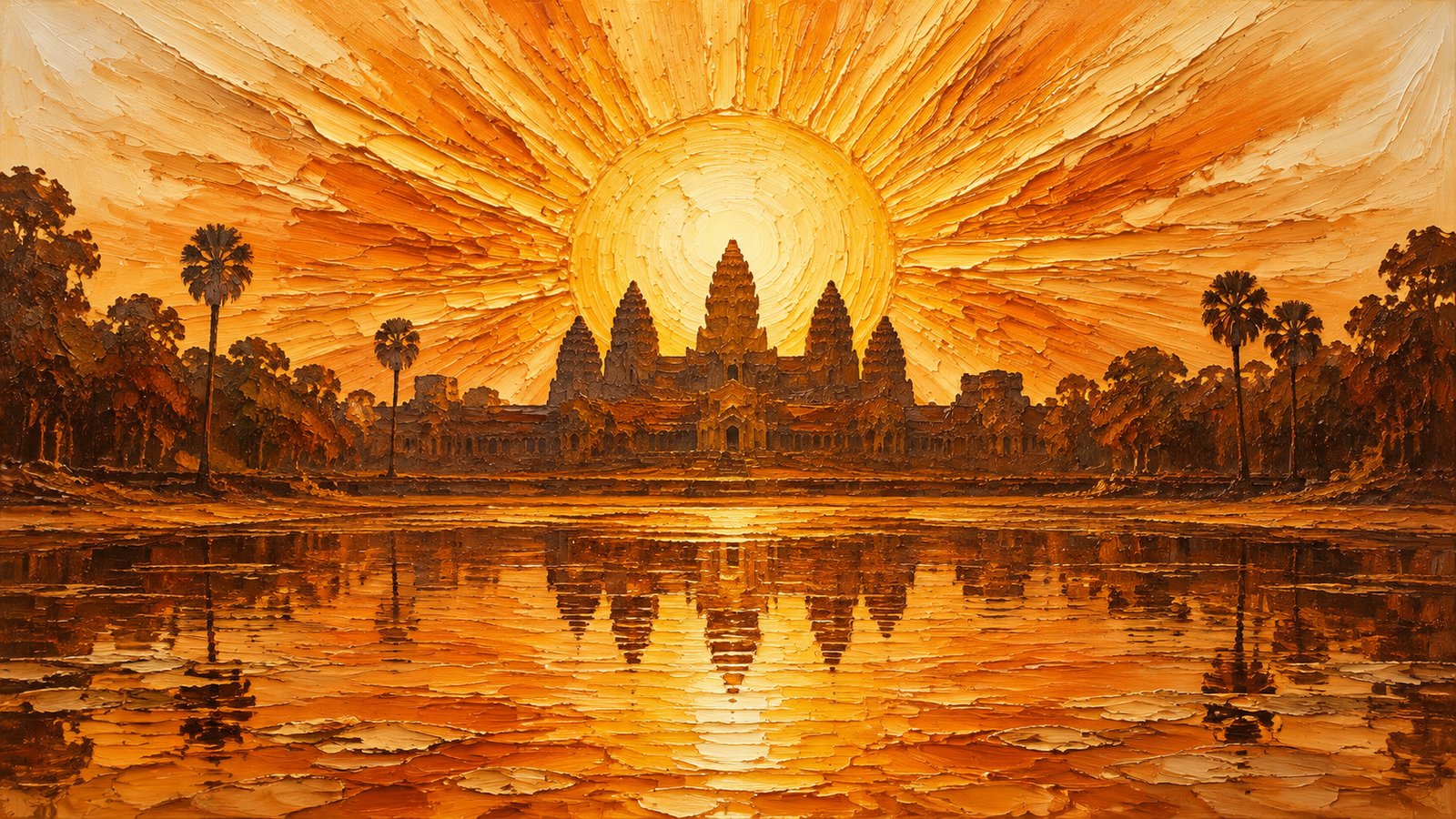
The stories of Surya did not stop at India's shores. For centuries, Indian traders and priests sailed south and east across the warm seas, and with them traveled their gods, their epics, and their love of the morning Sun. On the mainland of Southeast Asia, a people called the Khmer took those gifts and built something no one has ever outdone: a temple city the size of a county, crowned by the largest religious building on Earth.
Cambodia · AD 802 to 1431The city of temples
The Khmer Empire ruled much of Southeast Asia for more than six hundred years, from AD 802 to 1431. Its heart was Angkor, in what is now Cambodia: not one temple but a whole landscape of them - scores of temples, enormous reservoirs, canals and roads spread over some 400 square kilometers. UNESCO calls Angkor one of the most important archaeological sites in all of Southeast Asia, the capital of a civilization that shaped the whole region.
Cambodia · about AD 1122The king named for the Sun
The jewel of Angkor is Angkor Wat, built from about AD 1122 by the emperor Suryavarman the Second. Look at his name: it begins with Surya - the same sun god with the seven horses you met in India. His temple was dedicated to Vishnu, the preserver god, and it is one of the largest religious buildings ever created by anyone, anywhere. Where most Khmer temples face east, toward the sunrise, Angkor Wat faces west, the direction linked to Vishnu, and its long carved galleries of gods and battles are meant to be read as you walk with the setting Sun on your right.
Cambodia · measured by astronomersA calendar in stone
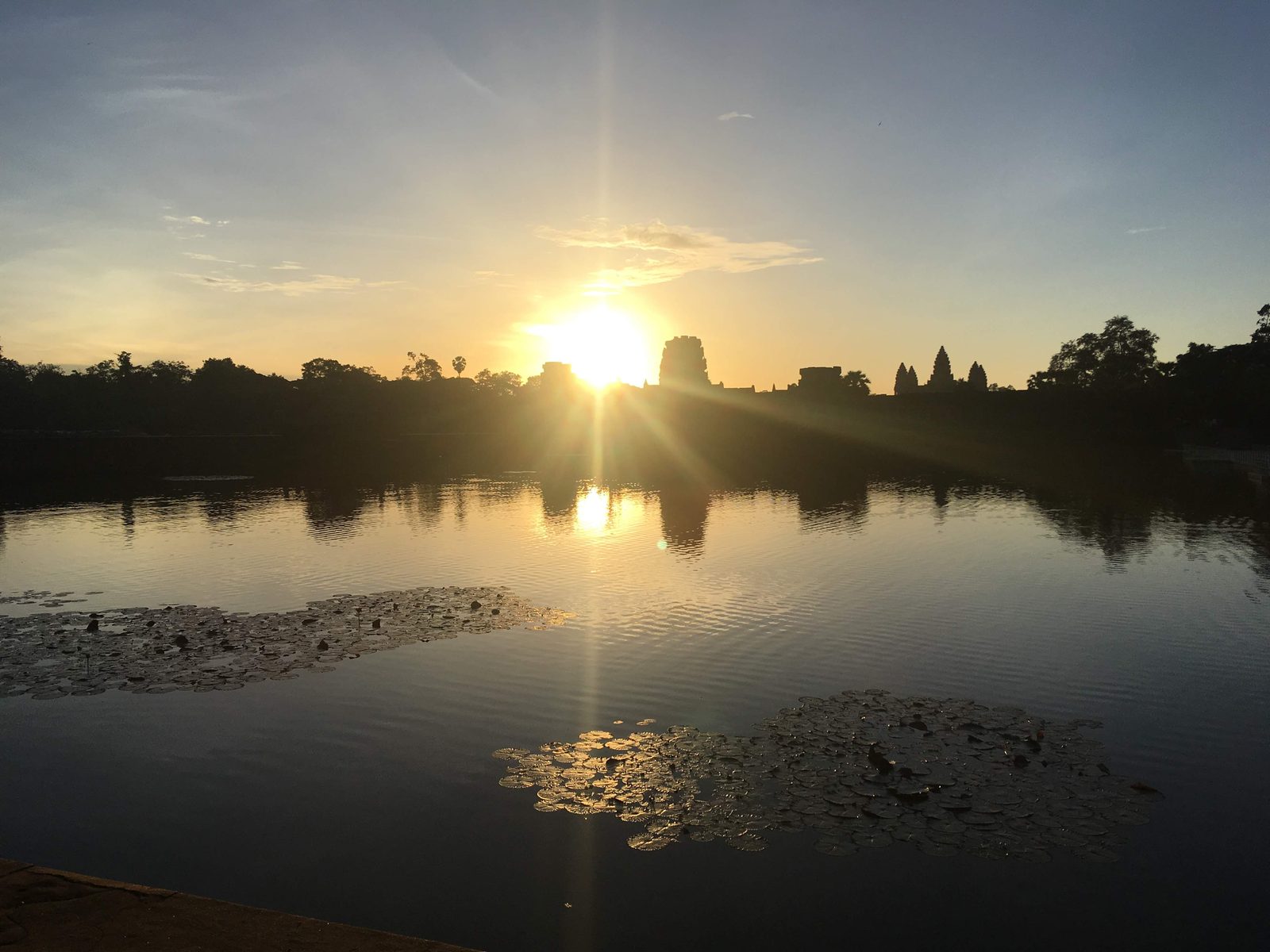
Here is the part that gives me chills. In 1976, three astronomers measured Angkor Wat carefully and published their findings in the journal Science: the temple's very measurements are tied to practical astronomy and to religious symbolism. The building is a calendar as well as a prayer. And on the two equinoxes, the days when night and day are exactly equal, the rising Sun stands directly above the central tower. Thousands of people still gather before dawn on those mornings to watch it happen - the Sun crowning the temple, then doubling itself in the still water of the moat.
And it is not only Angkor Wat. Archaeologists studying the whole region have found more than seventy alignments to the solstice sunrises and sunsets among the Angkor temples. Their conclusion is simple and beautiful: it was important to the Khmer that their temples be connected to the Sun. Each temple was a small model of the universe - and the Sun held its place in every one.
Bali · still prayed todayThe prayer that still greets the Sun
And in one place nearby, the old love never paused at all. On the island of Bali, Hinduism never left. Three times a day - six in the morning, noon, and six in the evening, the three hinges of the Sun's journey - the Puja Tri Sandhya sounds across the island: a Hindu prayer broadcast from temples, meeting halls, radio and television, announced by a priest's sacred bell and the music of the shadow-puppet plays. A researcher from the Smithsonian has documented how it became the heartbeat of the island's day. Balinese priests also keep a practice called Surya-Sevana - the service of Surya, the Sun - described in the journal Archipel. Three thousand years after the Rigveda was sung, someone is still greeting the Sun by name, every morning, on an island in the sea.
So the Sun of India became the Sun of the temple-builders, and it is greeted still. Now turn north, into China, where the oldest Sun stories begin with too much of a good thing: a sky with not one Sun, but ten.
Notes and sources
- UNESCO World Heritage · Angkor - the 400 km2 temple landscape, capitals of the Khmer Empire from the 9th to the 15th century, Angkor Wat and the Bayon.
- World History Encyclopedia · Angkor Wat - built from about AD 1122 under Suryavarman II, dedicated to Vishnu, among the largest religious buildings ever created, facing west.
- Journal of Skyscape Archaeology · Solstice Alignments at Angkor Wat and Nearby Temples - the equinox sunrise over the lotus towers, more than seventy solstice alignments, and why it mattered that Angkor's temples connected to the Sun.
- Smithsonian Center for Folklife and Cultural Heritage · A Balinese call to prayer - the Puja Tri Sandhya sounding across Bali at 6 am, noon and 6 pm, with the priest's bell; Bali's living Hinduism.
- Stencel, Gifford and Moron, Science (1976) · Astronomy and Cosmology at Angkor Wat - the temple's measurements tied to practical astronomy and religious symbolism.