Sunstory · Chapter 5
The chariot with seven horses
Told by Zora Rae deSole
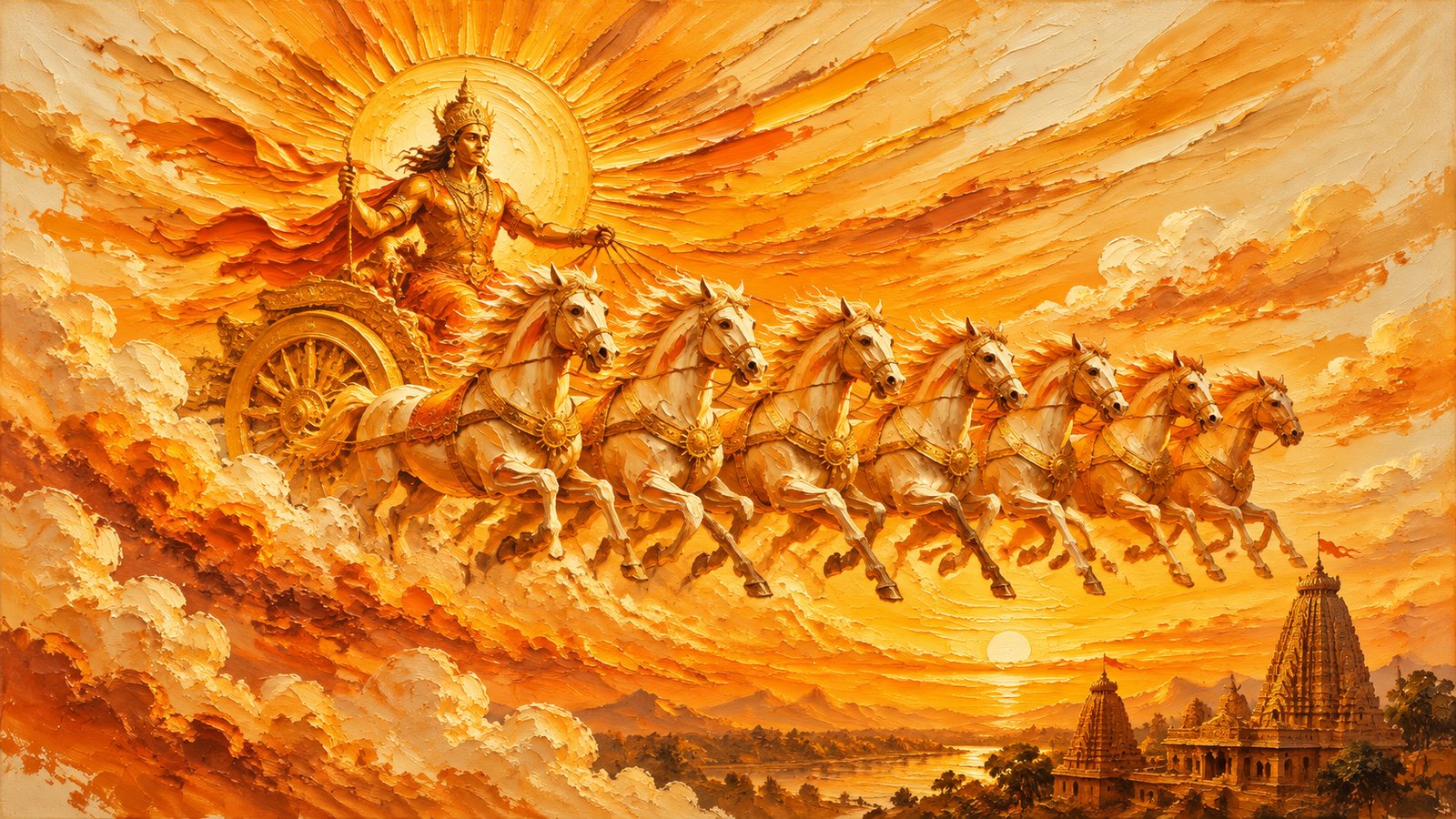
Cross the mountains and deserts east of Babylon and the story changes key. In India the Sun was not a falcon or a judge but a charioteer, and his story is written in the oldest religious book still loved anywhere: the Rigveda, a collection of songs composed between 1500 and 1000 BC. People were singing to the Sun in India while Stonehenge was already ancient.
India · from about 1500 BCThe god with a thousand rays
His name is Surya, and in that first age he stood among the three most important gods of all. He gathered names the way the Sun gathers light: Vivasvat, the Brilliant; Savitr, the Nourisher; Bhaskara, the Light-maker; and my favorite, Lokacaksuh, which means the Eye of the World. When the sun peeked over the horizon, that was the world opening its eye.
Every morning Surya climbs into a golden chariot pulled by seven horses, or, in some tellings, by a single horse with seven heads, for the seven colors of the rainbow and the seven centers of the body. The charioteer who drives the horses is Aruna, the red glow of dawn made into a person. Think of that the next time the sky goes pink before sunrise: that is the driver, arriving just ahead of the Sun. And every day, as he rides, Surya fights and defeats the demons of darkness. Not once a year. Every single day.
One of the loveliest old hymns, the Gayatri mantra, is addressed to the light of the Sun, and people have been reciting it, as a way of beginning prayer and study, for three thousand years.
The wife who hid from the lightSamjna and her shadow
The old stories do not make being the Sun sound easy. Surya's wife was Samjna, and she loved him, but his light was so fierce she could hardly bear to live beside it. So she did something clever and sad: she shaped a copy of herself out of her own shadow, a woman named Chaya, which means Shade, left her to keep the house, and went away to the forest in the form of a mare, to rest in the cool and quiet.
Surya missed her and went searching, and when he found her he became a stallion to win her back. Her father, the craftsman of the gods, did his part too: he trimmed away a little of the Sun's blazing edge, to make him easier to live with. Nothing that bright is wasted. From the shavings of the Sun's light, the gods forged their most famous weapons: Vishnu's discus and Shiva's trident.
Konark · 13th centuryA temple that is a chariot
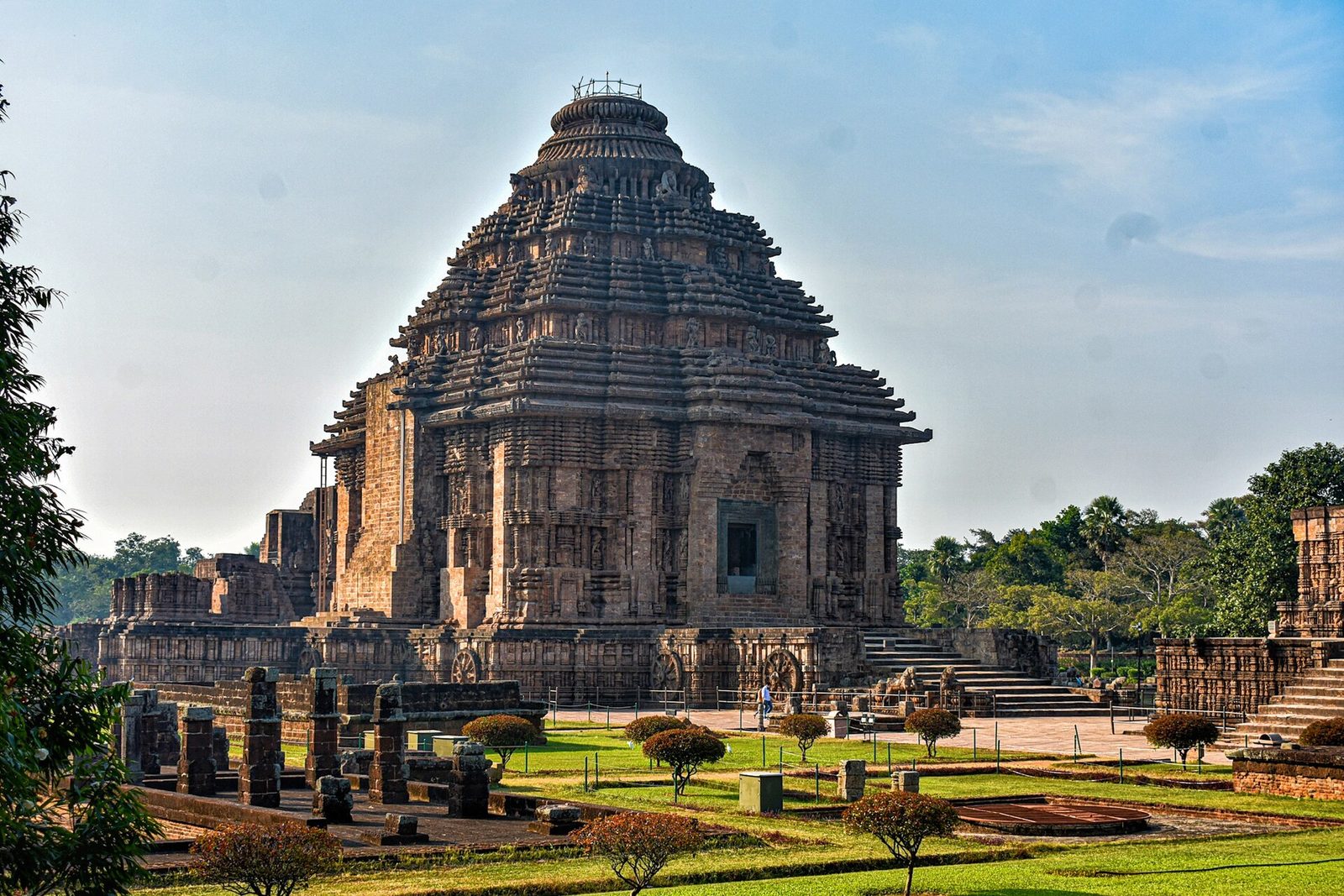
You can still visit the greatest monument to all of this. On the shore of the Bay of Bengal, in Odisha, stands the temple of Konark, built in the 13th century under King Narasimha I and laid out so that it catches the rays of the rising sun. The whole building is the chariot. Twenty-four enormous wheels are carved into its sides, each one a stone circle taller than a grown man, and a team of stone horses strains at the front, pulling the temple, and the god inside it, forever eastward into the morning. It is a UNESCO World Heritage site, one of the most famous temples in India, and it is really a story you can walk through: the Sun's chariot, built to human size, so that people could climb aboard.
TodayThe oldest worship that never stopped
Here is what makes India different from everywhere else we have been. In Egypt the Sun's temples are tombs and ruins; in Babylon they are dust. But in India the worship never ended. Hindus still greet the morning with the Surya Namaskar, the sun salutation, a slow bowing and stretching toward the rising Sun that millions of people know by heart. In the south, the harvest festival of Pongal is held in the Sun's honor.
And once a year, in Bihar, comes Chhath, a four-day festival that may be the largest act of sun worship left on Earth. Families keep strict fasts, then walk down to the rivers and stand in the water, shoulder to shoulder, holding out baskets of fruit and sweets. On the third evening they make their offering to the setting Sun, and the next morning they are back in the river before first light to greet the rising one. Millions of people, standing in the water, thanking the Sun both for going down and for coming back.
So the chariot never stopped rolling. It rolled south and east, carried across the sea by traders and priests, to a land where kings would raise whole cities of temples - and the largest religious building on Earth - to touch the Sun.
Notes and sources
- World History Encyclopedia · Surya - the names, the chariot and seven horses, Aruna, the Samjna story, the trimmed weapons, the Gayatri mantra, Konark, Pongal.
- UNESCO World Heritage · Sun Temple, Konarak - the chariot design, the 24 wheels and horses, the 13th-century date, the rising-sun setting.
- HistoryExtra (BBC History) · Sun gods and goddesses - the seven horses, the sun salutation still performed.
- Indian Express · Chhath Puja explained - the four-day festival, the fasts, the offerings to the setting and rising Sun in Bihar.