Sunstory · Chapter 18
The children who threw the Sun into the sky
Told by Zora Rae deSole
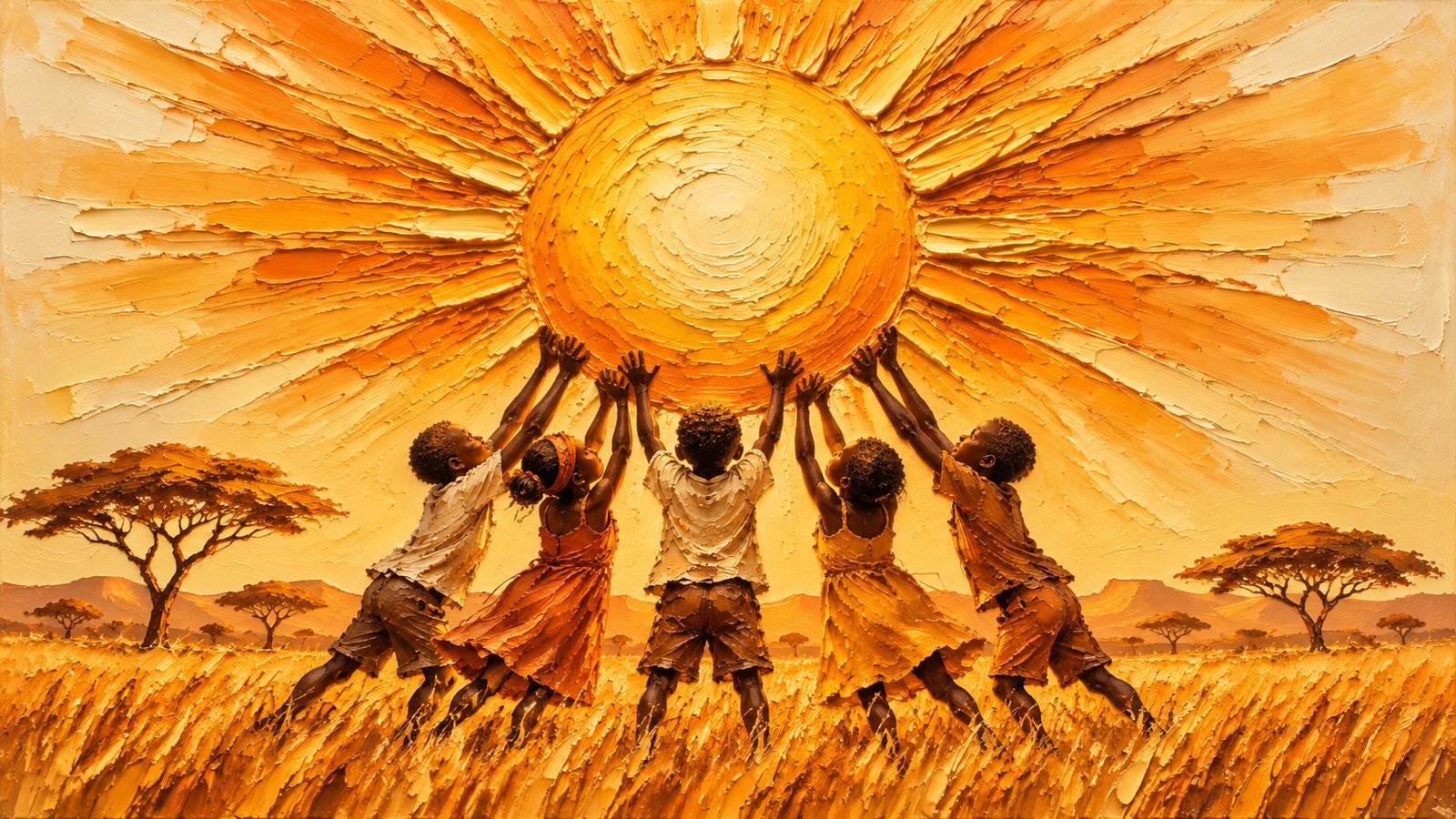
We end where everything began. Long before Newgrange, before Egypt, before anyone in this book built anything or wrote anything down, there were people in Africa under the same Sun. The human story started on that continent, and the Sun was in it from the very first page.
Southern Africa · written down in 1873The Sun was once a man
In the 1870s, in South Africa, a man named ||kabbo sat with a researcher named Lucy Lloyd and told her the old stories of his people, the /Xam. She wrote them down in notebooks, word by word, in his own language, and those notebooks are still kept and still read today. One of them holds maybe the oldest kind of Sun story there is.
The Sun, ||kabbo said, was once a man. He lived on Earth in his own house, and brightness came from his armpit. But he kept his arm down, so the light only fell around his own house. Everywhere else stayed dark.
So the mothers sent the children. The children found the old Sun asleep, and together they lifted him up and threw him into the sky. Up there he became round, and he has shone on everyone, everywhere, ever since. The notebooks say that once the Sun became round, he was never again a man.
Look at what that story hands to children. Not a god on a throne, not a king, not a priest. In one of the oldest Sun stories we can still hear, the children themselves put the light in the sky, so that it could shine on everybody. The kids did it. Remember that.
Sudan · about 750 BC to AD 350The kingdom the Sun's priests ruled
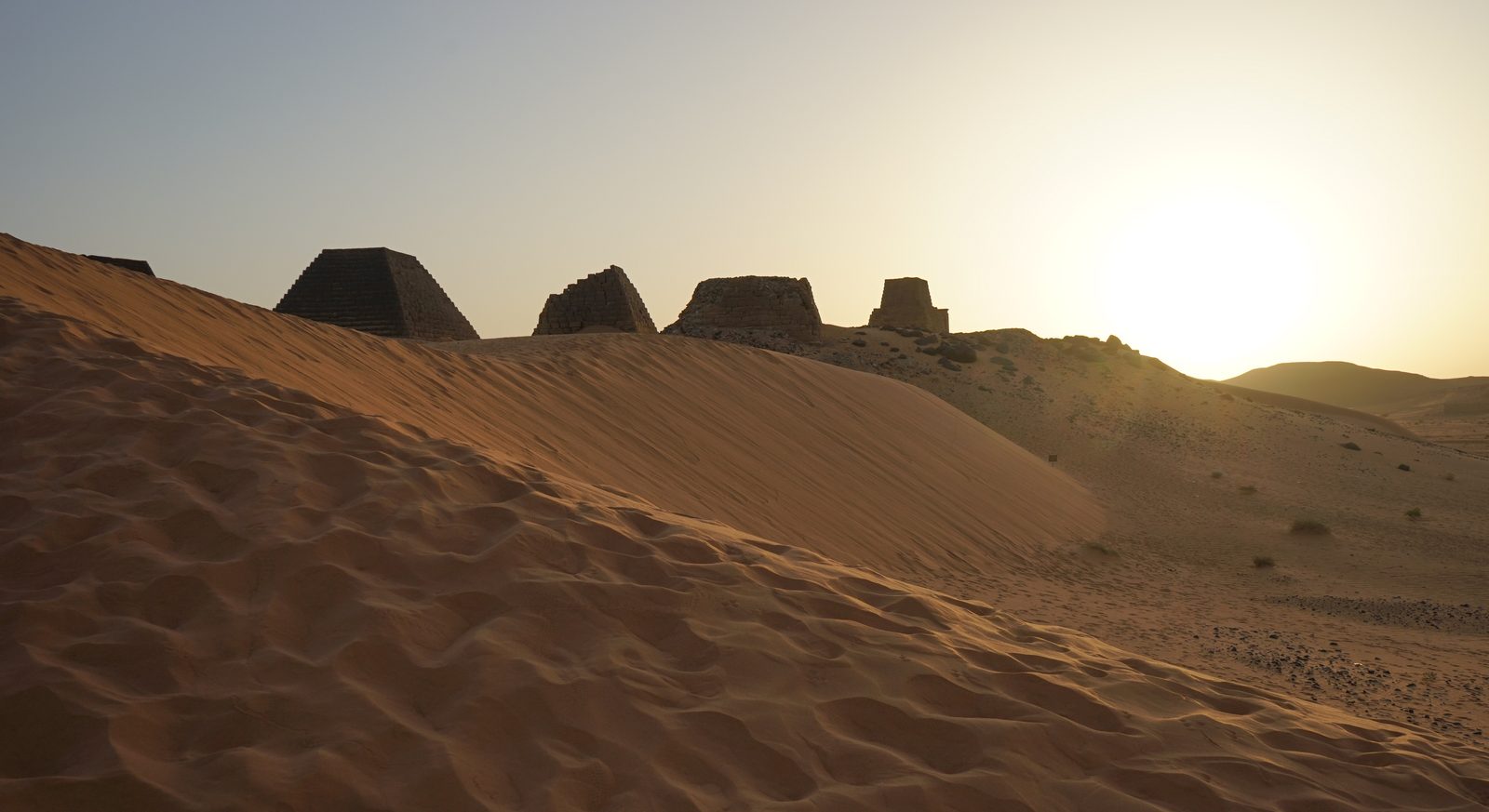
Now travel north, up the Nile past Egypt, into the land the Greeks called Nubia. Its people built the Kingdom of Kush, and Kush was no small neighbor. Around 750 BC its kings marched north and became pharaohs of Egypt itself, the 25th Dynasty, and ruled for close to a century. Later the capital moved south to Meroë, a city of broad avenues, busy iron furnaces, a great temple of Amun, and whole fields of steep, sharp pyramids that still stand in the desert sunrise.
Kush worshipped Amun, whom they called Amani, the god who had long before joined with Ra the Sun. And here the story turns strange. The priests of Amun claimed the right to choose each king, and to end him. When the god decided a king's time was finished, the priests sent word, and the king was expected to die. For generation after generation, kings obeyed.
Until one refused. A king the Greeks called Ergamenes had studied Greek philosophy, and when the letter came, he did not obey it. He marched to the temple with armed men and broke the priests' power forever. After him, Kush went its own way: its own writing, its own art, its own lion god Apedemak, and something rare anywhere in the ancient world, queens who ruled in their own right. They were called the Candaces. One of them, Amanirenas, went to war with Rome itself, and when the fighting ended, the peace treaty favored her, not the emperor Augustus. Rome almost never did that.
A Greek story about this landThe Table of the Sun
The Greeks heard rumors about this country and wondered. Herodotus, the world's first historian, writes that a Persian king once sent spies south into Nubia for one strange reason: to check a story about a Table of the Sun.
Here is the story they were sent to check. Outside the city, people said, there lay a meadow that filled up every night with roast meat, set out by the town's leaders. All day long, anyone who wished could come and eat their fill. And the people swore, this is the detail I love, that nobody really put it there at all. The earth itself produced it, fresh, every day, like light.
Was it true? Herodotus does not say. He only reports what he was told and lets you decide, which is a good habit for anyone reading history, including this book. But notice what the story dreams of: a land so loved by the Sun that dinner appears by itself, and every single person is welcome at the table. A Sun that feeds anyone who comes. People have been dreaming that dream for a very long time.
The human story opened in Africa, under the Sun. One of the oldest Sun stories we can still hear comes from African storytellers. The kings who served the Sun's own god ruled an African empire, until one of them decided a person matters more than a priest's letter. And the dream of a table where the Sun feeds everyone was dreamed on African soil. From here, the story belongs to everybody. One chapter remains, and it is ours.
Notes and sources
- The Digital Bleek & Lloyd, University of Cape Town · The children throw the sleeping Sun into the sky - ||kabbo's 1873 telling in Lucy Lloyd's /Xam notebooks: the Sun a man, the light from his armpit, the mothers sending the children, the Sun become round and never again a man.
- UNESCO World Heritage · Archaeological Sites of the Island of Meroe - the heartland of Kush, the royal city, Naqa and Musawwarat es-Sufra, the pyramids and temples, the kings who occupied Egypt for close to a century.
- World History Encyclopedia · Kingdom of Kush - the 25th Dynasty, the move to Meroë, the Temple of Amun, the priests' fatal letters and Ergamenes' refusal, Apedemak, the Meroitic script, the Candaces and Amanirenas' war with Rome.
- Herodotus · The Histories, Book 3, 17-23 (Godley translation, University of Chicago) - Cambyses' spies, the long-lived Ethiopians, and the Table of the Sun: the meadow, the nightly meat, and the earth that produced it of itself.