Sunstory · Chapter 1
The people who caught the light
Told by Zora Rae deSole
A history should begin with writing. That is a problem for us, because people loved the Sun for a very long time before anyone could write a word about it.
Their words are gone. But what they built is not. Before a single sentence of scripture existed, they left three kinds of proof behind: buildings that catch the light, circles that frame it, and gold that maps the sky. This chapter visits one of each.
Ireland · about 3200 BCThe tomb that catches the sunrise
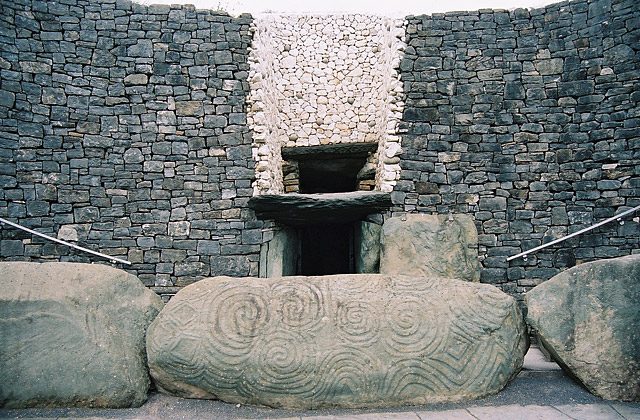
On a hill above the River Boyne in Ireland stands a great grass-covered mound called Newgrange. It was raised around 3200 BC, which makes it older than the pyramids of Egypt. It was a tomb: a long stone passage leading into a small chamber at the mound's heart.
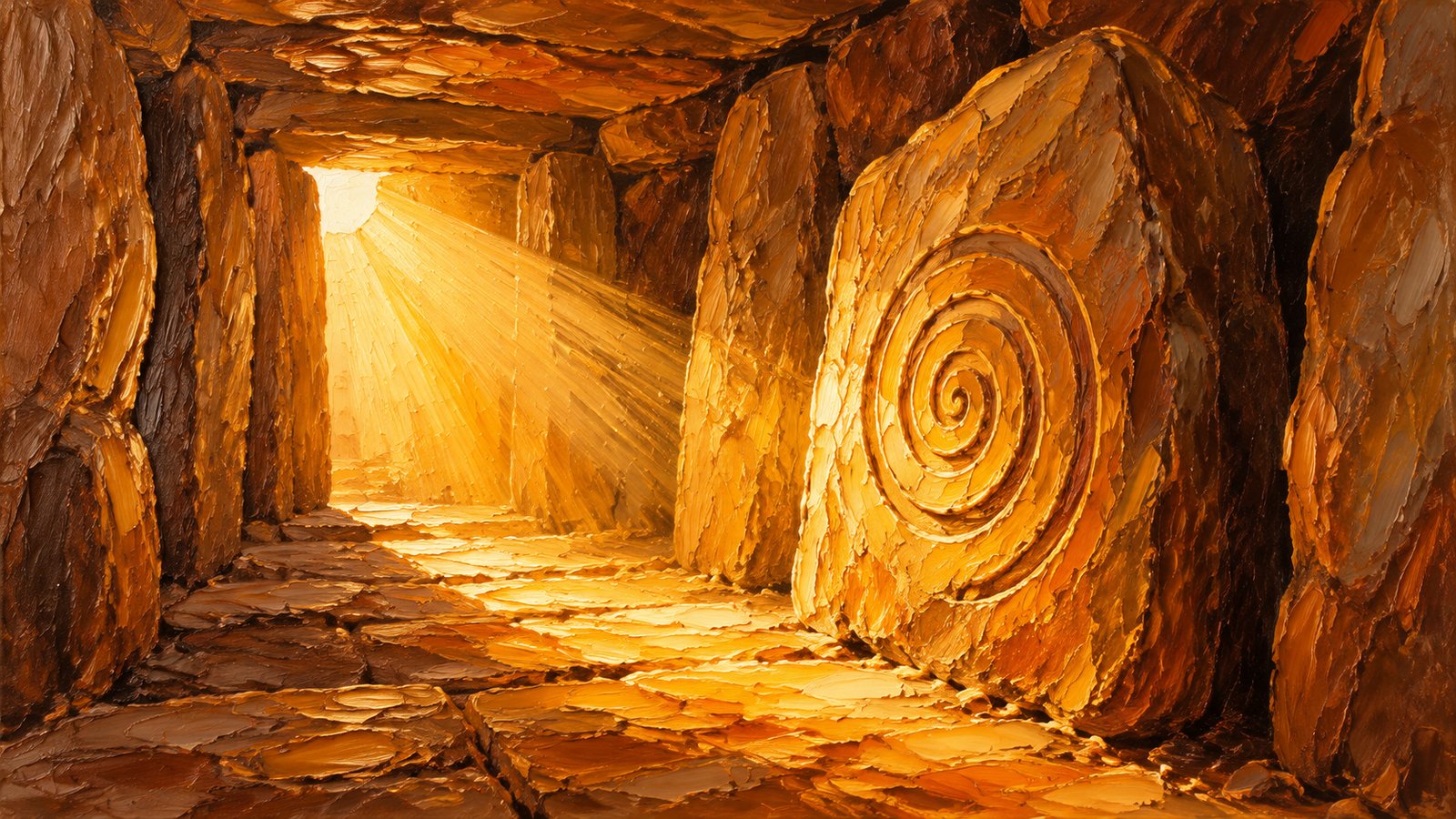
High above the entrance, the builders left a narrow slot, now called the roof-box. For a few mornings around December 21, the winter solstice, the shortest day of the year, the rising Sun shines through that slot, straight down the dark passage, and fills the chamber with light. The beam lands on a stone carved with a triple spiral, one of the most famous symbols of the ancient world.
No one saw this happen for thousands of years. Local people said the tomb filled with sunlight at midwinter, but the passage had collapsed and no one had ever watched it. In 1962 an archaeologist named Michael O'Kelly began to dig, found the roof-box, and guessed what it was for. On December 21, 1967, he and his team stood in the dark chamber and watched the light come in, the first people to see it since prehistory.
Why did they build it? We do not know, and it is better to say so. One old guess: the midwinter light was meant to wake the dead and guide them onward. What we can say for certain is that the darkest day of the year mattered so much to these people that they engineered a way to catch the Sun on that one morning, like a cup set out to catch rain.
England · about 2500 BCThe circle that frames the Sun
Seven hundred years later, farmers in the south of England raised the great stones of Stonehenge. The whole monument is aimed at the sky. Stand in the center on midsummer morning and the Sun rises beside the Heel Stone. Stand there on midwinter afternoon and it sets between the uprights of the tallest trilithon, the arch of stones at the circle's heart. When archaeologists scanned the monument with lasers, they found that the stones framing the solstice were the most carefully shaped of all.
Midwinter seems to have mattered most. At Durrington Walls, the settlement nearby where the builders lived, archaeologists find the bones of pigs killed in midwinter, animals carried in from far away. People were gathering in the cold, in great numbers, to feast and hold ceremonies.
Think about what midwinter meant before electricity. The nights are long. The ground is frozen. Nothing grows. Day after day the Sun sinks lower, and around the solstice it seems to stand still, as if it might be fading for good. English Heritage suggests the gathering was about honouring the Sun so that it would return. And it did return. Every year the light turns, the days lengthen, and the world wakes up again. Stonehenge is a machine for noticing that turn, built by people who had no clocks, no calendars on paper, and all the time in the world to watch the sky.
Germany · about 1800 BCA photograph of the sky, made of gold
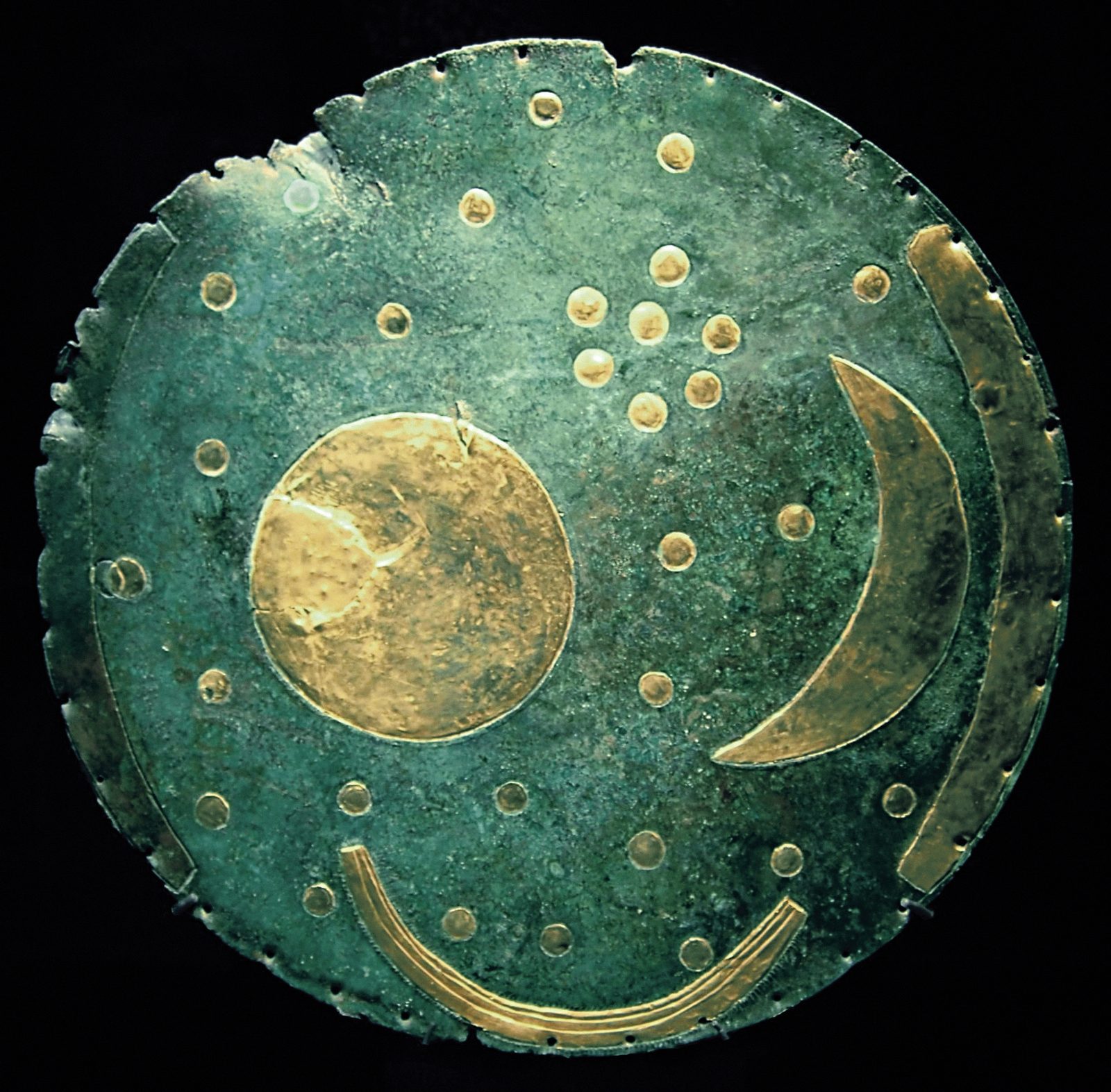
Seven hundred years after Stonehenge, and across the sea, someone in what is now Germany made something small enough to hold in two hands: a bronze disc, pressed with gold. On it you can see a full golden circle, the Sun, beside a crescent Moon and a field of stars. Two gold arcs mark the horizons. And along the bottom rides a little boat.
That boat is the magic detail. It is the oldest known picture in Europe of an idea we will meet again and again in this book: the Sun does not die at night. It sails through the dark, on a ship beneath the world, so that it can rise again in the morning.
The State Museum of Prehistory in Halle, where the disc lives today, calls it the world's oldest concrete depiction of cosmic phenomena, and UNESCO placed it on the Memory of the World register in 2013. It also has a detective story. Looters found it with metal detectors on a hill called the Mittelberg in 1999 and sold it into the black market. Police recovered it in a sting in 2002. A 3,600-year-old map of the sky, nearly lost to thieves, now belongs to everyone.
Denmark · about 1400 BCA chariot for the Sun
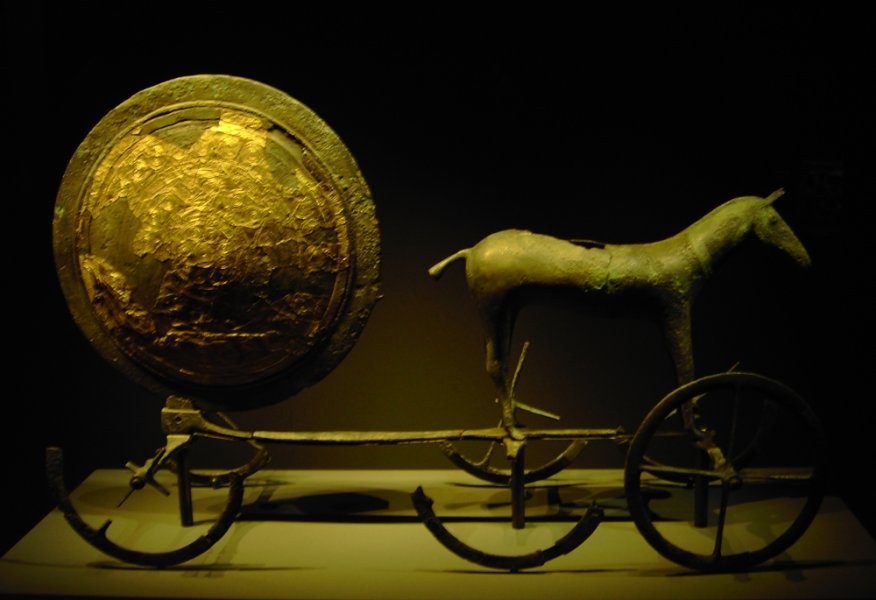
One September day in 1902, a farmer ploughing a Danish bog called Trundholm Mose struck something in the soil. It turned out to be one of the most beautiful objects of the Bronze Age: a small bronze horse, pulling a bronze disc covered in gold, the whole thing mounted on wheels.
The National Museum of Denmark reads it as a story in metal. The Sun travels across the sky forever, and a divine horse pulls it. The wheels are the point: this Sun moves. It was made around 1400 BC, and the spiral patterns on the golden disc mark it as Nordic work.
Danes love it still. The sun chariot is printed on the Danish 1000-krone banknote, so the little Bronze Age Sun rides through modern pockets every day.
Look at what people made before anyone had written a word about the Sun: a tomb that catches it, a circle that frames it, a map of the sky that carries it, a chariot that moves it. The worship came first. The words came later.
In the next chapter, the words begin, on the banks of the Nile, where the Sun got a name the world still remembers: Ra.
Notes and sources
- National Museum of Ireland · The winter solstice at Newgrange - dates, roof-box, the 1967 rediscovery, and what the light may have meant.
- English Heritage · Understanding Stonehenge - solstice alignments, laser survey, midwinter feasting at Durrington Walls.
- State Museum of Prehistory, Halle · The Nebra sky disc - what the disc shows, the sun boat, the looting and recovery, the UNESCO listing.
- National Museum of Denmark · The Sun Chariot - dating, meaning, the 1902 find, the banknote.